Location: Campbelltown NSW
Posts: 1,864
Club: M.A.L.A.K.A.S.
Car: 2020 AMG GT C
Posting this because the "is it an M129 or M130" question has come up four times this month and I keep typing the same answer. Stickying it so we can point new buyers at it.
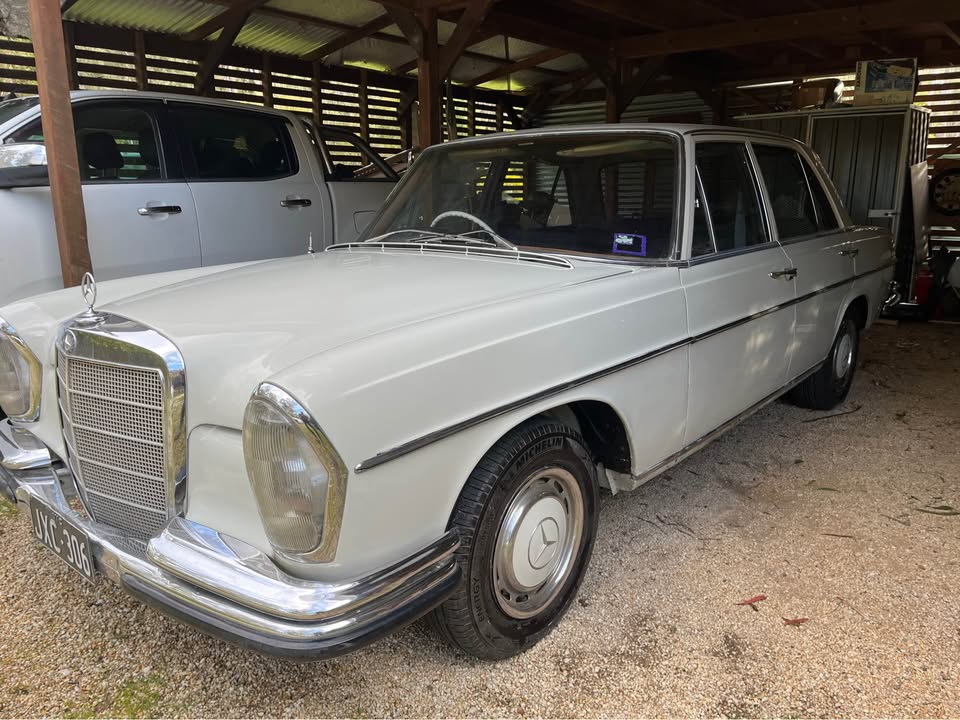
If you are about to buy a 1960s or early 1970s W108, W109, W111, W113, or W114, this is what you need to know about the engine before you put money down.
The mid-size single overhead cam straight-six engine family ran from 1951 to about 1976. Four main variants matter for our era. I'll cover them in order, then the buying checklist at the bottom.
M180 - the base engine (1951 onwards)
2.2 litre. 2,196 cc. Bore × stroke 80 mm × 72.8 mm. Mercedes' first over-square engine in a production car - bore wider than stroke. Single overhead camshaft, reverse-flow cylinder head, four main bearings.
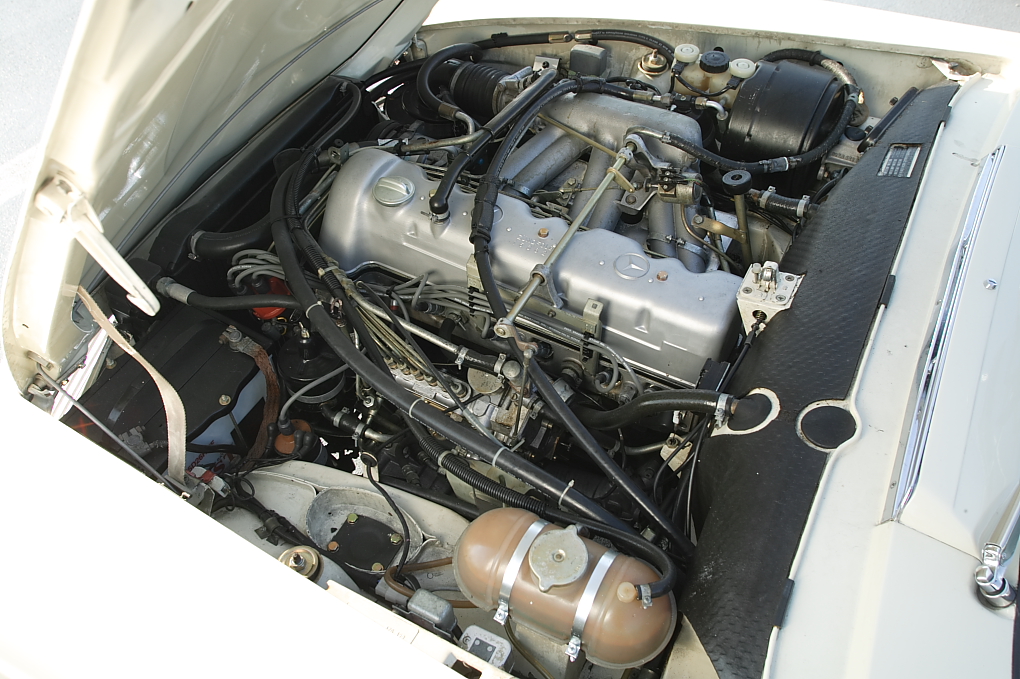
Originally rated 80 PS. Up-rated repeatedly over the years. The M180 lived in the W187 220, the W180 220a, the W105 219, the W111 220b/220Sb, and (carbureted in 2.3 form as the M180.954) in the W114 230 / 230S "stroker" of the early 1970s.
If the data plate shows "M180" and the car is a 230 or 230S, it is the up-stroked 2.3 litre version of the original block. Same architecture, longer stroke, 2,308 cc. People confuse this with the M114 - which is a different (newer) engine. More on that in a seperate thread if anyone wants it.
M127 - the fuel-injected 2.2 (1958-1965ish)
Same 2.2 litre block as the M180, but with Bosch mechanical fuel injection - a two-plunger pump. Rated 113-134 PS depending on tune. Lived in the W111 220SE Coupe/Cabrio (the "Heckflosse" fintail era).
If you are looking at a 220SE from the early to mid-1960s, it is an M127. The injection is mechanical, period-correct, and rebuildable but not cheap. Chris_K knows more about these than I do.
M129 - the 2.5 litre fuel-injected (1965-1968)
2.5 litre. 2,496 cc. Bore × stroke 82 mm × 78.8 mm. The big change from the M180/M127: seven main bearings (up from four), larger oil pump, six-plunger injection pump (up from two), shortened connecting rods to accommodate the longer stroke in an unchanged block height, larger valve diameters.
The M129 lived in the W108 250SE sedan and the W113 250SL "Pagoda". Carburetted version of the same displacement (used in the W108 250S) is technically a different engine code - I have seen it called M108 in some references and M129 in others, and the truth is the model series got renamed during the production run. If the data plate shows M108 and the car is a 250S, accept it. If it shows M129 and the car is a 250SE, accept it. If it shows the other way around, ask more questions.
Australian-delivery note: the 250SE landed here from 1966 onwards via Mercedes-Benz Australia/Pacific. Most surviving examples are RHD factory-delivery. The fuel injection on these is reliable when looked after and a nightmare when it isn't. Cohline 2240 fuel hose on the high-pressure runs. Not the cheap stuff.
The hot-start issue. M129s vaporise fuel in summer heat. The injection pump sits over the manifold and gets cooked. Symptom: car runs fine cold, drive 15 minutes, shut off, won't restart for 10 minutes. From 1968 onwards Mercedes specified a thicker insulating gasket on the injection-pump heat shield. Boonie's old thread from 2017 had a long diagnosis post about this. If you are buying a pre-1968 M129 and the seller says "it just doesn't like the heat," walk away unless you are budgeted for the heat shield gasket retrofit. The fix exists. It costs time.
M130 - the 2.8 litre (1968-1972)
2.8 litre. 2,778 cc. Bore × stroke 86.5 mm × 78.8 mm. The ultimate variant of the mid-size six. Achieved by boring the M129 out by 4.5 mm. Per the Mercedes-Benz Group Archive Stuttgart this was the maximum practical enlargement of the block - the water passages between cylinders had to be deleted because the bores were too close. (Hugo will confirm. He has the actual factory document.)
The M130 lived in:
- W108 280S / 280SE (1968-1972)
- W109 280SE/SEL (1968-1972)
- W113 280SL (1968-1971) - the "Pagoda" 280
- W109 300SE / 300SEL (1968-1972) - yes, the 300SE/SEL of this era ran the 2.8 M130 too, not the M186 "big six." The big six was discontinued in 1968.
- The 6.3 W109 (300SEL 6.3) is a different beast entirely - that is an M100 V8, not in this family.
The M130 is generally regarded as the most refined of the mid-size sixes. Same hot-start vulnerability as the M129 on the injection-pump heat shield. Same fix.
The buying checklist
If you are looking at any of these cars and the seller doesn't know which engine is in it:
- Read the data plate. Either on the firewall or - on later cars - on the inner LH guard. Engine code is the first three digits after the M. M 130 098 12... = M130, etc.
- Count the main bearings if you can get the sump off. M180/M127 = four. M129/M130 = seven. This is the easiest physical check on a stripped engine.
- Check the bore × stroke against the data plate. 80×72.8 = M180. 82×78.8 = M129/M108. 86.5×78.8 = M130.
- Check the injection pump. Two plungers = M127. Six plungers = M129 or M130. No injection (carburettors) = M180 or the carburetted M108 250S variant.
- Drive it hot. Run it 30 minutes minimum, shut off in the workshop, walk inside for a coffee, come back out, try to restart it. If it cranks but won't fire for several minutes, you have a heat-soak issue. Budget the heat shield gasket retrofit. Cohline 2240 on the high-pressure side while you are in there.
- Ask if the previous owner ever replaced the injection pump. A correctly rebuilt period pump is worth real money. A modern Chinese aftermarket replacement is a downgrade.
Per Glass's Guide AU classic supplement March 2019, values are: M180 sedans (W108 250S, W111 220Sb) $18-32k typical, M129 sedans (W108 250SE) $28-48k typical, M130 sedans (W108 280SE, W109) $32-60k typical, W113 Pagodas 1.5x to 3x sedan values depending on year and originality.
Production-history reference (sourced from Mercedes-Benz factory records and Wikipedia "Mercedes-Benz M180 engine" article - reproduced with Wikimedia Commons reuse permissions, CC BY-SA):
The M180 was Mercedes-Benz's straight-six replacement for the post-war M186, introduced in 1951 with the 220 (W187). The architecture defined Mercedes inline-sixes for over two decades.
Key M180 configurations through production:
- M180.920 - 2.2L, single Solex carb, 80 bhp - the 220a / 220S sedan from 1951
- M180.940 - 2.2L, twin Solex carbs, 105 bhp - the 220SE (W128) from 1958
- M180.945 - 2.2L, Bosch mechanical fuel injection (two-plunger pump), 120 bhp - the 220SE Coupe (W111)
- M180.954 - 2.5L carbureted variant, 130 bhp - the 250S (W108) from 1965
Block, crank and rod architecture are common across the family. Variations are in head, induction, ignition and bore/stroke. The 2.3L M180 in the 230 / 230S (W110, W114) from 1968 is the up-stroked variant of the original 2.2L architecture.
For W108/W109 buyers: the data plate is the final authority. The M180 designation appears on the build plate and the engine number stamp on the block must match. The 2.5 carbureted sedans got the M108 (engine code 108.920) which shares the M180 block but with revised head and induction - EPC microfilms from 1967 treat the M108 as distinct from the M129.
Sources: Mercedes-Benz factory production records (Stuttgart archive); Wikipedia article "Mercedes-Benz M180 engine" (CC BY-SA 4.0, used per Wikimedia Commons reuse). Glass's Guide AU classic supplement March 2019 for valuations.
Happy to answer specific questions below. Will edit this post to add corrections as members raise them.
- Billy